
The Government's plan for your family's drinking water is a pillowcase and a quarter teaspoon of bleach. There is a better one.
What the Be Ready checklist asks you to store, what happens on day four, and what 16,000 homes in Devon found out in 2024.
By HoldFast Ready
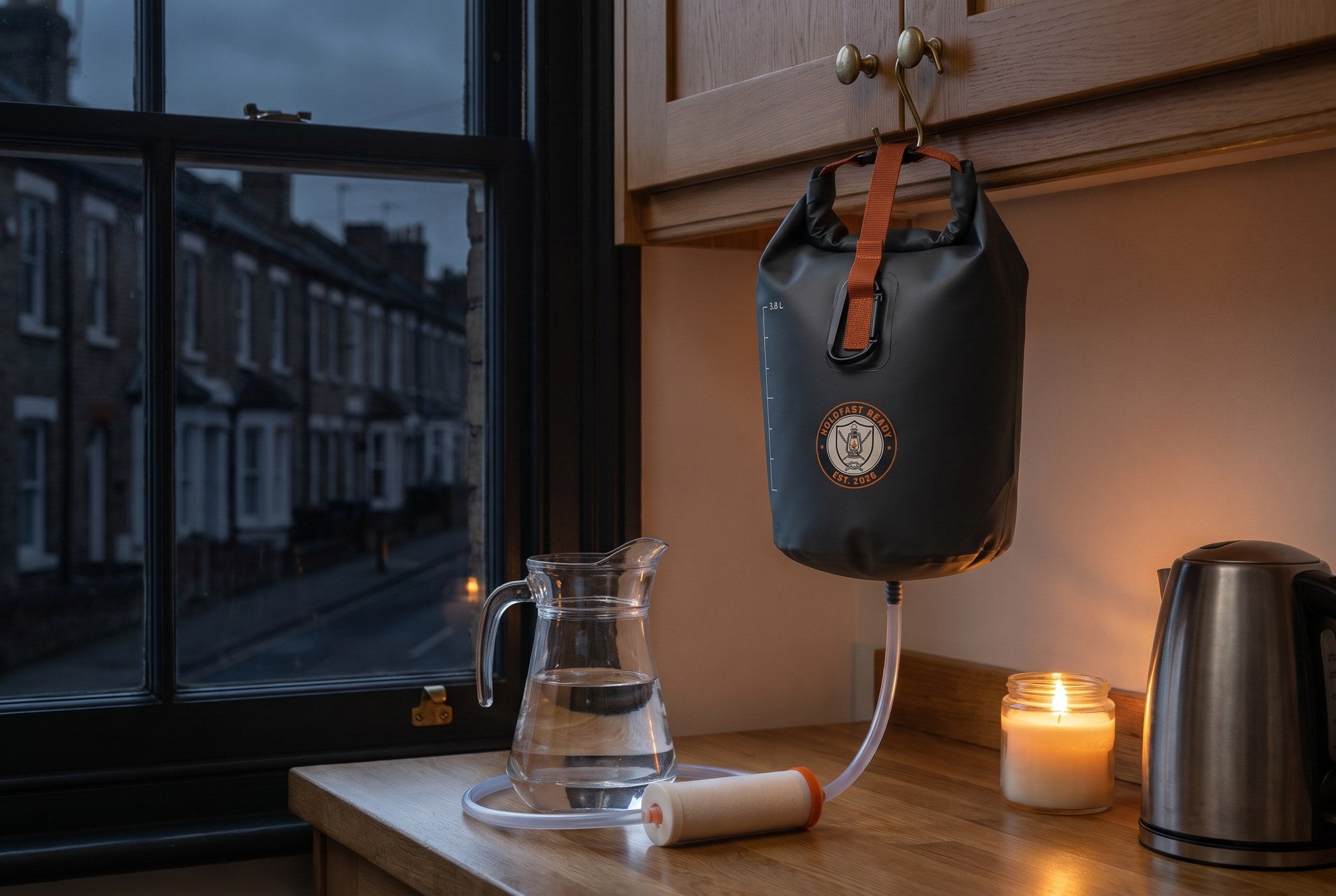
Most of us are not preppers. We have tins in the cupboard because that is where tins go, a torch in the kitchen drawer with batteries that may or may not work, and a vague plan that involves the kettle. Then, in October 2026, the Government launched Be Ready and asked every household to be able to manage for three days without help.
The item on that list almost nobody has is water. Not food: most homes could eat for a week from the cupboard. Water. As one reader put it, “I do think a lot of people forget water.”
So we did the maths the Government did not print on the poster.
36 litres, and nowhere to put them
Be Ready's figure is 3 litres of drinking water per person per day, for 3 days. More, it adds, for cooking and washing.
For a family of four that is 36 litres. Twenty-four of the big 1.5 litre bottles. Thirty-six kilograms.
Where exactly are you keeping them? Under the stairs, with the hoover? In a one-bed flat with “no space to swing a cat”? Behind the bath panel? And when you have found the space, you have 36 litres that start going stale the day you buy them, in plastic you will have to swap out every few months.
There is a reason people read the advice, nod, and buy one multipack of water at Tesco. The advice is right. It is just not practical for the people it was written for.
See the kit that replaces the 36 litres →
“And after 3 days..?”
That was the most-liked comment under the Daily Mail's report on the Be Ready launch: 4,324 people clicked agree. The second most-liked: “So what magically happens after three days?”
It is a fair question, and the answer is in the Government's own wording: being ready for 3 days “helps you manage while support reaches those most in need.” Three days is when help starts arriving. Not when the tap works.
What the help looks like is written down too. When the mains fail, your water company has to provide at least 10 litres per person per day, usually from a bowser on a car park or a bottled-water station. Ten litres covers drinking, a kettle and a flannel wash. Then you queue for the next ten. One villager described it: “the bowser was several miles away, by the time he walked there it was empty, as were the local shops.”
Stored water only goes one way. Every bottle you drink is one fewer. The question is not how much you can store. It is what you do when the last one is empty and the tap is still dry.
It has already happened here, three times in five years
None of this needs a war or a cyberattack. It needs weather and old pipes.
Brixham, Devon, May 2024. A parasite got into the mains. Around 16,000 households and businesses were told to boil everything they drank. The last homes were still boiling on 8 July, almost eight weeks later. South West Water's compensation rose to £215 a household, which bought a lot of bottled water and no sleep.
Tunbridge Wells, Kent, winter 2025. A fault at the treatment works cut tap water to more than 24,000 households and businesses from 29 November. The council declared a major incident on 2 December. The boil notice came off on 12 December, almost two weeks on. The same town lost water again in January.
Storm Arwen, November 2021. Nearly one million homes lost power, and nearly 4,000 were still without it after more than a week. Be Ready's own power-cut page carries the line most people have never read: “Mains water supply to your home could also be disrupted during and after power cuts.” Pumps and treatment works run on electricity. When the lights go, the water can follow.
Devon, Kent, the north-east. A parasite, a fault, a storm. None was predicted, and in every one the bottled water ran out before the problem did.
Get HoldFast Wellspring with free UK delivery →
What the Chief Medical Officers would tell you to do
In December 2025 the four UK Chief Medical Officers published the scripts that would be read out on Radio 2 and Radio 4 in a national power cut, on the assumption the power “might be out for a number of days.” The water section is worth reading in full. Here is the plan.
First, find water: “Water from reservoirs, fresh-water lakes and free flowing streams can also be made safer to drink.” Rivers only “as a last resort.”
Then, in their words: “Get something to filter the water - a coffee filter, pillowcase or bedsheet.” Then boil it, or use tablets, or “add approximately one-quarter of a teaspoon of unscented, household bleach for every 10 litres of water” and “leave it to stand for 15 minutes.”
That is the official method. A pillowcase, then bleach, for the family's drinking water.
A pillowcase catches leaves. It does nothing to what actually makes a household ill from untreated water, the bacteria and parasites you cannot see, which is why the bleach comes next. And boiling, the thing we all reach for, needs the one thing a power cut takes away: a way to heat a pan, for every litre, for days.
The CMOs are not wrong. They were writing for people with nothing better in the house. You can do better than a pillowcase for less than a weekly shop.
Stop storing clean water. Start making it.
Britain is not short of water. There is a stream, a beck, a pond, a lake or a water butt within walking distance of most homes in the country. The problem has never been finding water. It is what is living in it.
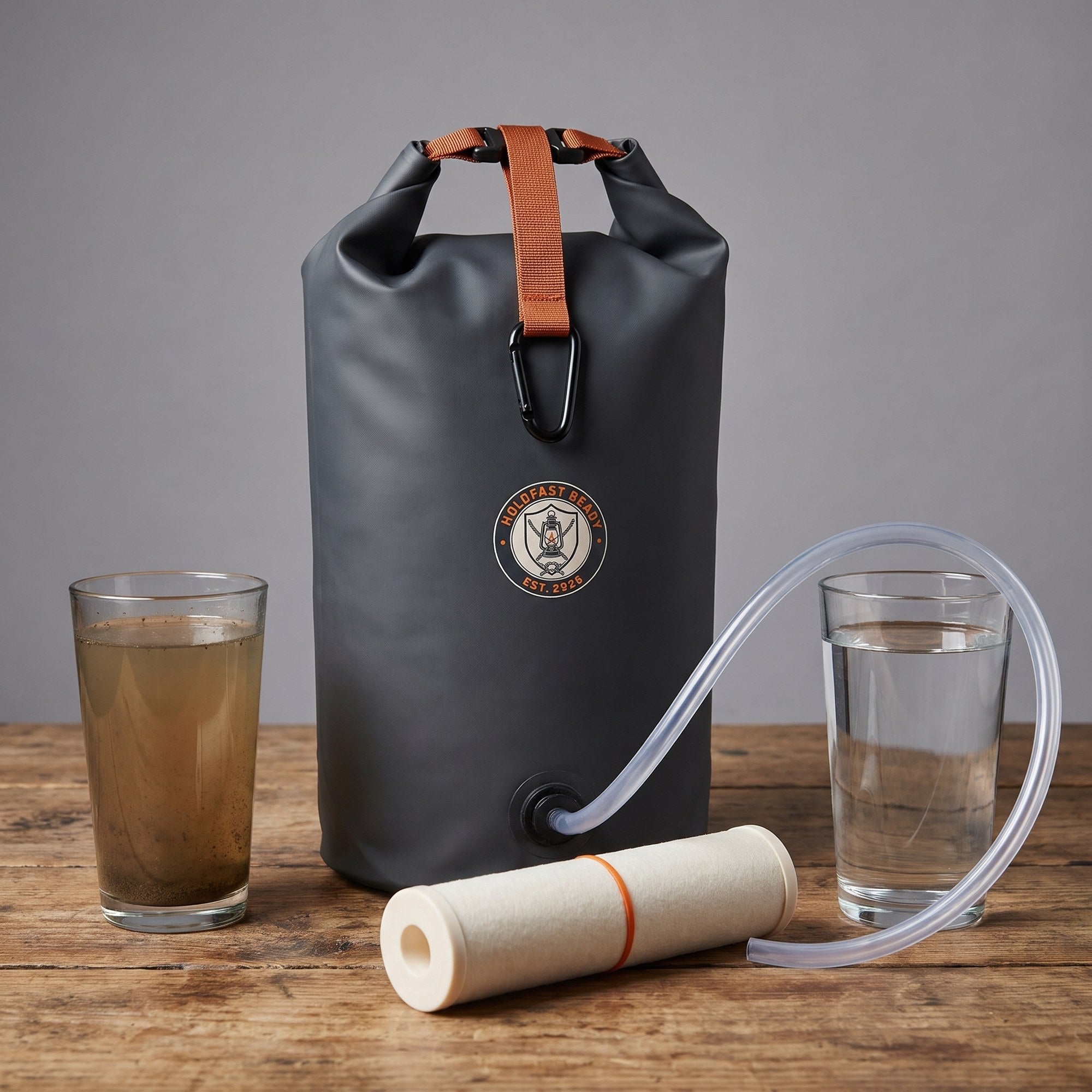
HoldFast Wellspring is a gravity filter. Inside the cartridge are thousands of hollow fibres with pores 0.1 micron wide. Bacteria, parasites and microplastics are physically too big to get through; the manufacturer's testing puts removal at 99.99%. Nothing is added to the water. No bleach to measure, no wait.
Fill the 3.8 litre (1 gallon) bag from the stream or the water butt. Hang it on a branch, a cupboard handle or a door frame. Open the line and walk away. Clean water collects in the pouch, a saucepan or, with the adaptor, a bottle, while you sort the torch, the kids and the tea. No pumping. No sucking on a straw, one person at a time. No electricity.
A filter straw keeps one hiker going. A gravity bag keeps a household going, which is the point one Mumsnetter made unprompted: “they're slow for a whole household, so a gravity bag or jug version is easier if you'd be filtering for several people.”
See how it works, and what's in the box →
What it does not do, because you should know before you buy
It does not remove viruses. No hollow-fibre filter does, at any price; the US CDC's guidance is blunt that filters of 0.3 micron or smaller remove bacteria and parasites but not viruses. It does not remove heavy metals, pesticides, fuel or salt. If the water is floodwater, or you suspect a chemical spill, filter it and then boil it or use tablets, exactly as the CMOs advise.
For the water you would actually be using in Britain, a stream, a pond, the rain off the shed roof, tap water under a notice, bacteria and parasites are the risk. That is what this is for. We would rather lose a sale than have you find that out in week two.
The practical version of being ready
One cartridge is rated by the manufacturer for up to 5,700 litres (1,500 gallons). For a family of four at Be Ready's 3 litres a day, that is more than a year of drinking water from a bag that folds flat in the cupboard under the stairs. Stored dry, it does not expire. It is ready next winter and the one after.
The kit is £89.99 instead of £119.99 at the moment, with free UK delivery, and it comes with two guides we wrote for homes like yours, worth £30: The Three-Day Larder, a food storage guide and workbook, and Sensible, Not Scared, our guide to a ready home.
And it is covered by the HoldFast Promise: 90 days, any reason, full refund. Hang it from the shed, fill it from the butt, decide for yourself.
Be Ready asked for three days. “And after 3 days..?” asked 4,324 people. This is the answer to both.
Get HoldFast Wellspring: £89.99, free UK delivery, 90-day HoldFast Promise →